

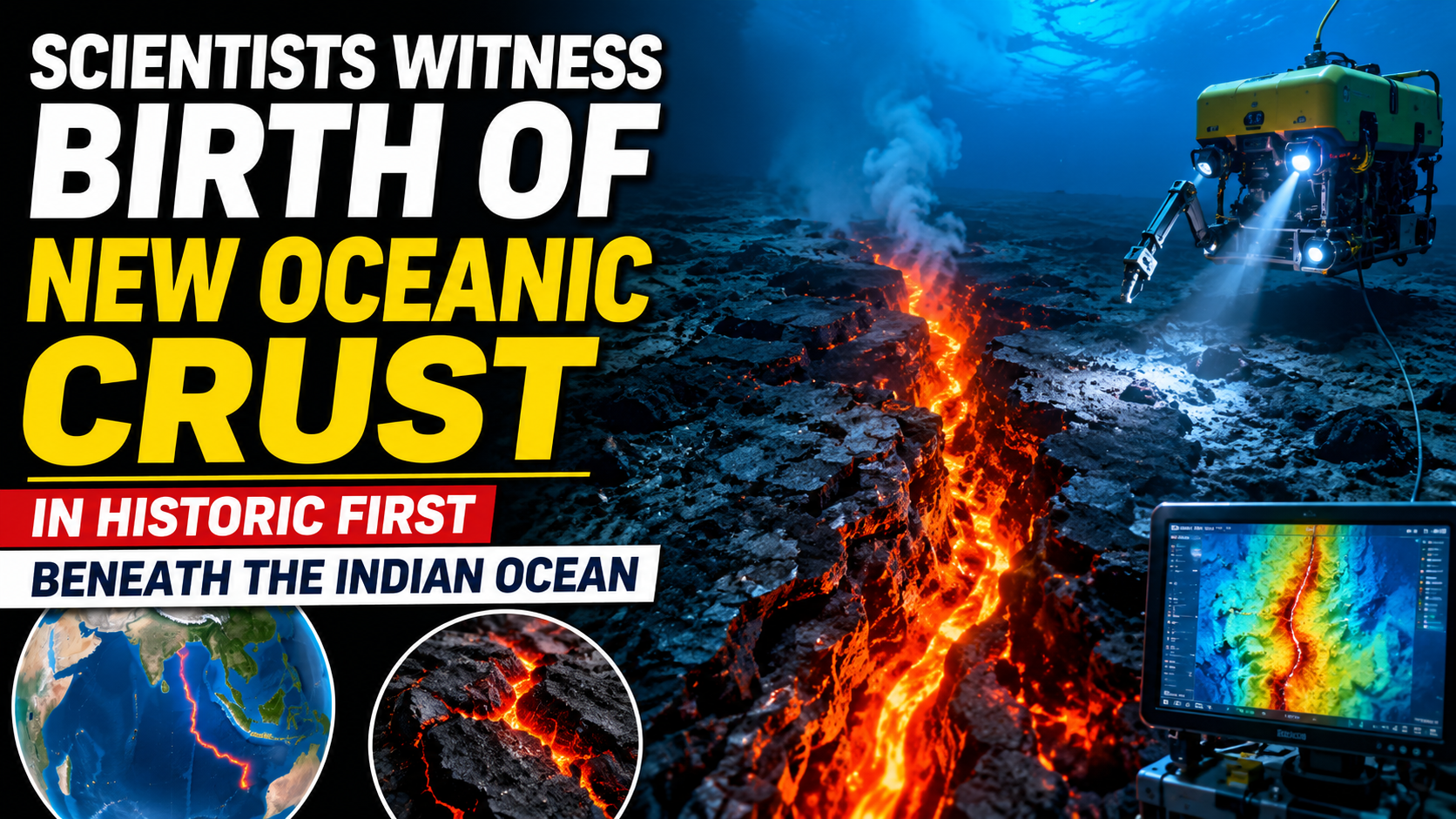
Landmark observations offer the clearest evidence yet of how Earth’s seafloor spreads, resolving a decades-old geological mystery.
July 9, 2026 — In a breakthrough that geologists have pursued for decades, scientists have directly observed a section of Earth’s ocean floor splitting apart and creating new oceanic crust in real time. The unprecedented event, recorded deep beneath the Southeast Indian Ridge in the Indian Ocean, marks the first in-situ observation of seafloor spreading — the fundamental geological process responsible for continuously reshaping nearly two-thirds of Earth’s surface.
The observations, published on July 8 in the journal Nature, were made possible by a newly deployed underwater observatory that happened to be in place just weeks before the rare geological event unfolded in April 2024. Researchers say the findings provide the strongest evidence yet that seafloor spreading does not occur gradually, but instead happens in sudden, dramatic bursts separated by decades of relative quiet.
A Rare Event Captured by Chance
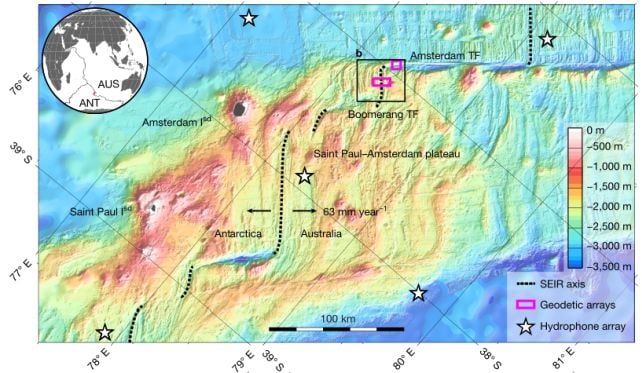
The international research team had installed an array of more than 20 monitoring instruments across a roughly 100-kilometre section of the Southeast Indian Ridge, located between Australia and Antarctica, as part of the OHA-GEODAMS seafloor observatory.
Their original goal was modest: measure slow tectonic plate movements amounting to only a few centimetres per year.
Instead, on April 26, 2024, the instruments detected a dramatic geological event.
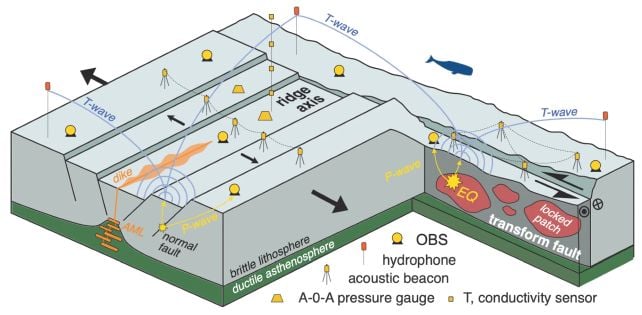
Within just over two weeks, the ridge split apart as molten rock surged upward from Earth’s mantle. Massive underground sheets of magma, known as dikes, forced the tectonic plates apart, triggering thousands of small earthquakes before lava erupted onto the ocean floor and cooled into brand-new oceanic crust.
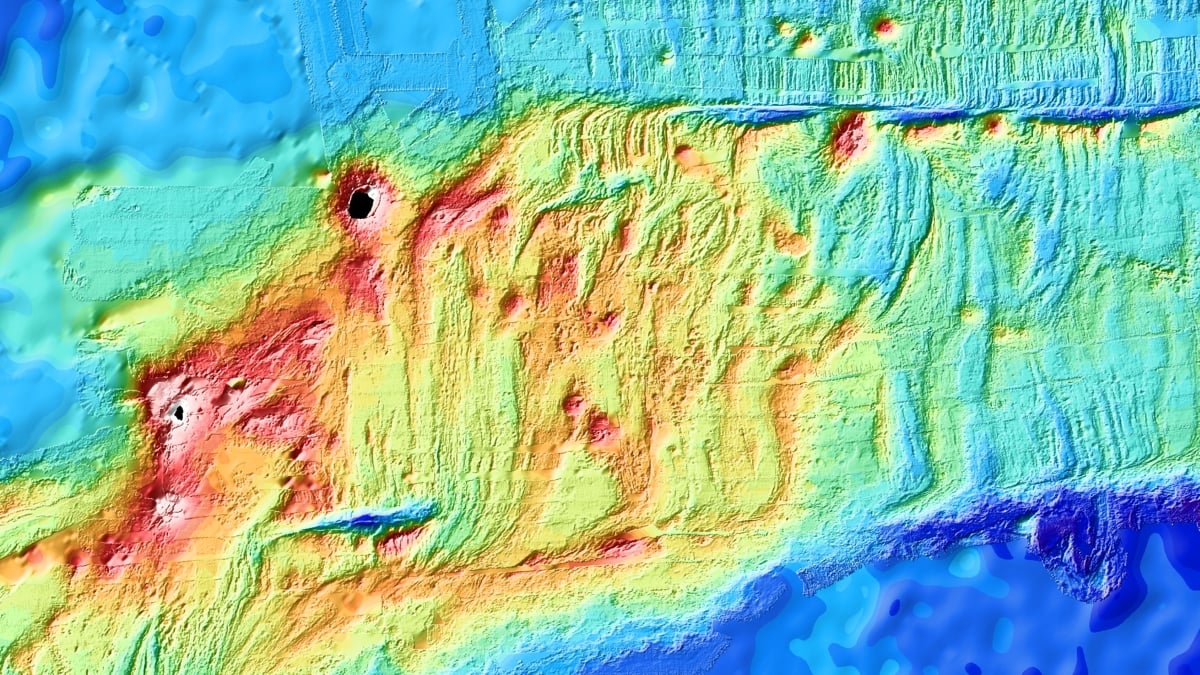
Researchers estimate that roughly 150–160 million cubic metres of magma were injected into the crust during the event.
Ocean Floor Shifted by Several Metres
The observatory revealed movements that surprised even the scientists involved.
Instead of the expected gradual drift, sections of the seafloor suddenly moved between two and four metres in opposite directions. At the same time, the central valley along the ridge collapsed by approximately 4.2 metres as magma drained from below.
At its fastest point, the tectonic plates separated at nearly five centimetres per minute—around half a million times faster than the average long-term spreading rate of roughly 6.3 centimetres per year.
According to the researchers, those few days of activity effectively accounted for 30 to 60 years of normal tectonic motion.
Solving a Long-Standing Geological Puzzle
For decades, scientists have known how quickly Earth’s tectonic plates move apart based on satellite measurements and geological records.
However, adding together movement caused solely by earthquakes never fully explained the observed rate of seafloor spreading.
The new observations provide the missing piece.
Much of the plate movement occurred silently as magma forced open the crust before fault movement generated earthquakes. This means that significant tectonic displacement happens without producing the amount of seismic activity scientists previously expected.
The discovery helps explain why previous earthquake records consistently underestimated the total amount of crustal spreading occurring beneath the oceans.
“We Did Not Dream of Capturing Such a Massive Event”
Lead researcher Jean-Yves Royer, a marine geophysicist at France’s National Centre for Scientific Research (CNRS), described the observations as beyond anything the team had anticipated.
According to Royer, the researchers expected only to measure the slow accumulation of tectonic stress.
Instead, they recorded what he described as a “once-in-forty-year event,” during which the ridge suddenly failed, allowing accumulated magma beneath the seafloor to rapidly propagate through the oceanic crust.
The extraordinary timing was largely a matter of luck.
The monitoring instruments had been deployed only two months before the event occurred, giving scientists an unprecedented opportunity to watch a complete seafloor spreading episode unfold from beginning to end.
Why Seafloor Spreading Matters
Seafloor spreading is one of the central processes behind plate tectonics, the theory explaining the movement of Earth’s outer shell.
At mid-ocean ridges—an interconnected underwater mountain chain stretching approximately 65,000 kilometres around the globe—tectonic plates slowly move apart.
As they separate, molten rock rises from the mantle, cools, and solidifies to form new oceanic crust.
This continuous recycling creates new seafloor while older crust is eventually destroyed at subduction zones elsewhere on the planet.
Although scientists have understood the theory for more than half a century, directly observing the process has proven exceptionally difficult because nearly all mid-ocean ridges lie thousands of metres beneath the ocean surface in remote locations.
New Technology Opens a Window into Earth’s Interior
The success of the OHA-GEODAMS observatory demonstrates the growing capabilities of modern seafloor monitoring technology.
The system combined hydrophones, direct-path acoustic ranging instruments, bottom-pressure sensors, and repeated mapping of the ocean floor to produce an unusually detailed record of both seismic and geological changes.
Scientists believe similar observatories could now be deployed along other active mid-ocean ridges to better understand how Earth’s crust evolves over time and how magma moves beneath the seafloor.
Wider Scientific Significance
Beyond solving questions about plate tectonics, the findings may improve scientists’ understanding of submarine volcanic eruptions, earthquake generation, and the geological processes that have shaped Earth’s surface for billions of years.
The observations also provide an important benchmark for computer models used to study the dynamics of Earth’s interior.
Researchers say directly measuring the interaction between magma intrusion, fault movement and seafloor deformation offers insights that were previously impossible to obtain through remote sensing or laboratory experiments alone.
Conclusion
For generations, the creation of Earth’s oceanic crust has remained one of geology’s most fundamental yet least directly observed processes.
The chance deployment of a sophisticated underwater observatory just weeks before a major tectonic event has now allowed scientists to witness that process in action for the first time.
The discovery not only confirms long-held theories about how new seafloor forms but also reshapes scientific understanding of how Earth’s tectonic plates move—revealing that the planet’s surface is built not through slow, constant motion, but through rare, powerful bursts of geological activity hidden beneath the oceans.