

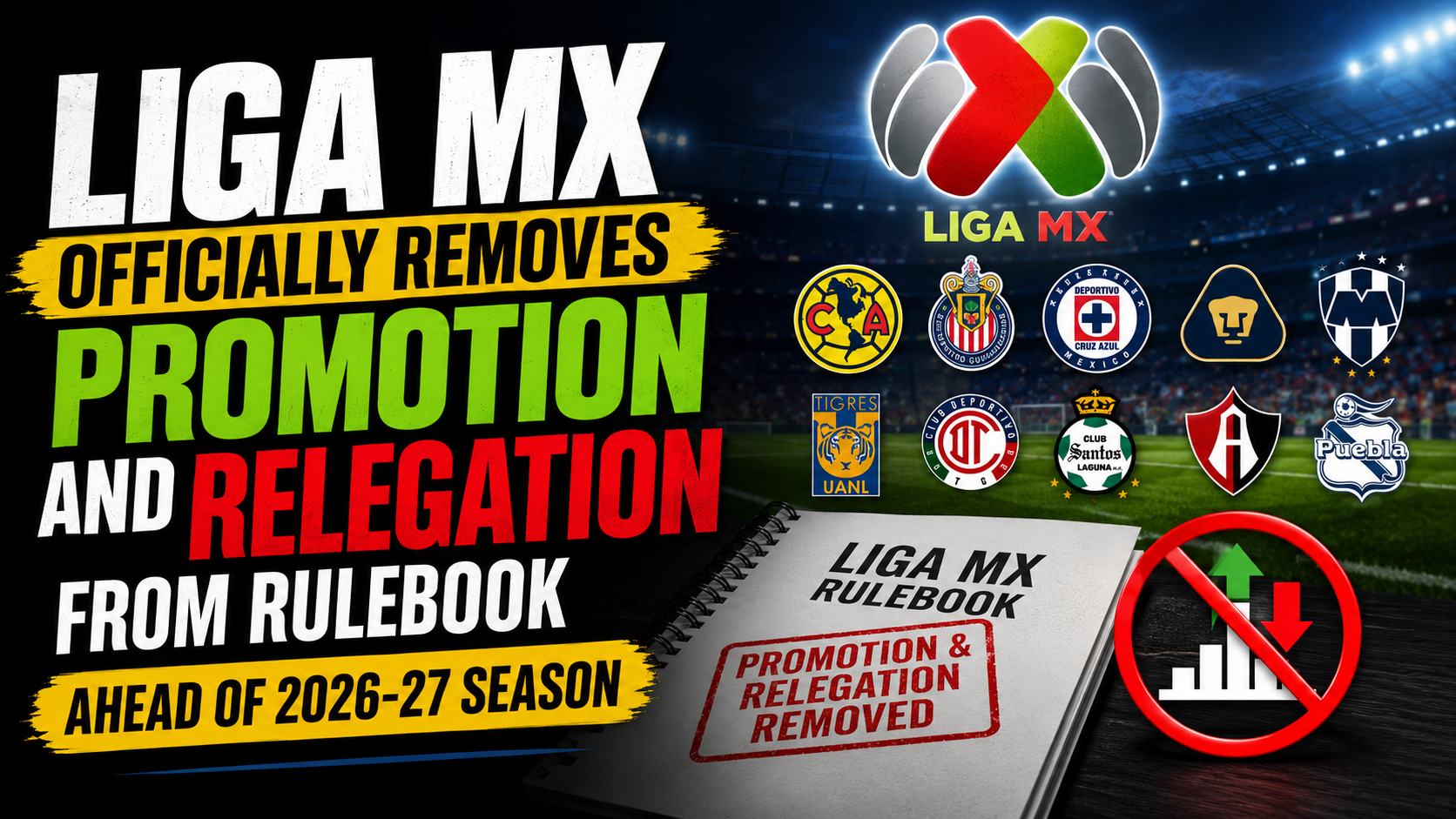
Liga MX has officially removed the promotion and relegation system from its regulations, marking one of the biggest structural changes in Mexican football in recent years. The update comes ahead of the 2026-27 season and also eliminates the financial penalties previously imposed through the league’s coefficient table. The changes were confirmed in the latest version of Liga MX’s regulations and have reignited debate over the future of competition in Mexico’s top football division.
Liga MX Officially Updates Its Rulebook
Liga MX has formally eliminated promotion and relegation from its official regulations, making permanent a system that had already been suspended since 2020.
The change appears in the league’s updated regulatory framework, replacing the previous temporary suspension with a permanent modification to the competition rules. The decision represents a major shift in the structure of professional football in Mexico.
The updated regulations also remove references to the previous relegation-related mechanisms that had remained in earlier versions of the rulebook.
Coefficient Table Fines Also Eliminated
Alongside the removal of promotion and relegation, Liga MX has abolished the financial penalties linked to the Tabla de Cocientes, or coefficient table.
Under the previous system, the clubs with the lowest coefficients were required to pay fines because relegation had been suspended. Those funds were intended to support the development of clubs in Mexico’s lower divisions.
With the latest rule changes, those fines have also been removed, ending a mechanism that had been in place since the suspension of relegation.
Background: Promotion and Relegation Suspended in 2020
Liga MX suspended promotion and relegation in 2020 during the COVID-19 pandemic, citing financial challenges facing clubs across Mexican football.
League officials argued at the time that removing relegation temporarily would provide greater financial stability and allow clubs to recover from the economic impact of the pandemic.
The suspension was originally presented as a multi-year measure while the league evaluated long-term reforms.
Debate Continues After Previous CAS Proceedings
The future of promotion and relegation has remained a controversial topic in Mexican football.
Several clubs from the lower divisions previously challenged the suspension before the Court of Arbitration for Sport (CAS), arguing that the system should return once the agreed suspension period expired.
Although the legal proceedings focused on the original suspension, the latest regulatory update has once again placed Liga MX’s governance under public scrutiny as football stakeholders assess the long-term consequences of the decision.
What the New Rules Mean
With promotion and relegation no longer part of Liga MX’s regulations, clubs in the top division will no longer face the risk of dropping to a lower league based on sporting results.
Likewise, clubs competing in Mexico’s lower divisions no longer have a direct sporting pathway to earn promotion to Liga MX through the traditional promotion-and-relegation system.
Supporters of the move argue that greater financial stability can help clubs invest in infrastructure and long-term development. Critics, however, believe removing relegation may reduce competitive pressure and limit opportunities for ambitious lower-division teams.
Major Structural Change Ahead of the 2026-27 Season
The latest amendment is part of a broader series of organizational changes introduced ahead of the 2026-27 Liga MX season.
In addition to modifying competition formats in recent years, the league has now reshaped one of the most fundamental elements of its sporting structure by officially removing promotion, relegation, and coefficient-table fines from its regulations.
The long-term impact of these reforms on competitive balance, club development, and Mexican football as a whole will likely remain a key topic of discussion in the seasons ahead.